Long before plastic pumpkins and bags of candy, the last night of October meant something different in the Highlands and Islands. It was the hinge of the year, the end of the harvest and the start of winter. On that night, the world of the living and the otherworld drew uncomfortably close. Our ancestors called it Samhain, and a surprising amount of what we do on Halloween still carries its fingerprints.
Summer’s end
In Scottish Gaelic it’s Samhainn, and the name is usually translated as “summer’s end.” The old Gaelic year had two halves, light and dark, and Samhain was the door between them. The celebration ran from sunset on October 31 into November 1. In the Gaelic reckoning, the day began at nightfall. Even today, the Gaelic name for November is an t-Samhain, and Halloween night is Oidhche Shamhna, the night of Samhain.
Practically, this was when the cattle came down from summer pasture. Families decided which animals they could feed through the winter and slaughtered the rest. That meant feasting. It also meant a season of uncertainty, with the long dark months ahead and no guarantee everyone would see spring.
A night when the veil was thin
People believed the boundary between worlds weakened at Samhain. The spirits of the dead and the fairy folk, the aos sí, could move freely among the living. That belief shaped nearly everything people did that night. Some customs kept the spirits at bay, and some kept them happy. Others used the open door to peek at the future.
Fire on the hilltops
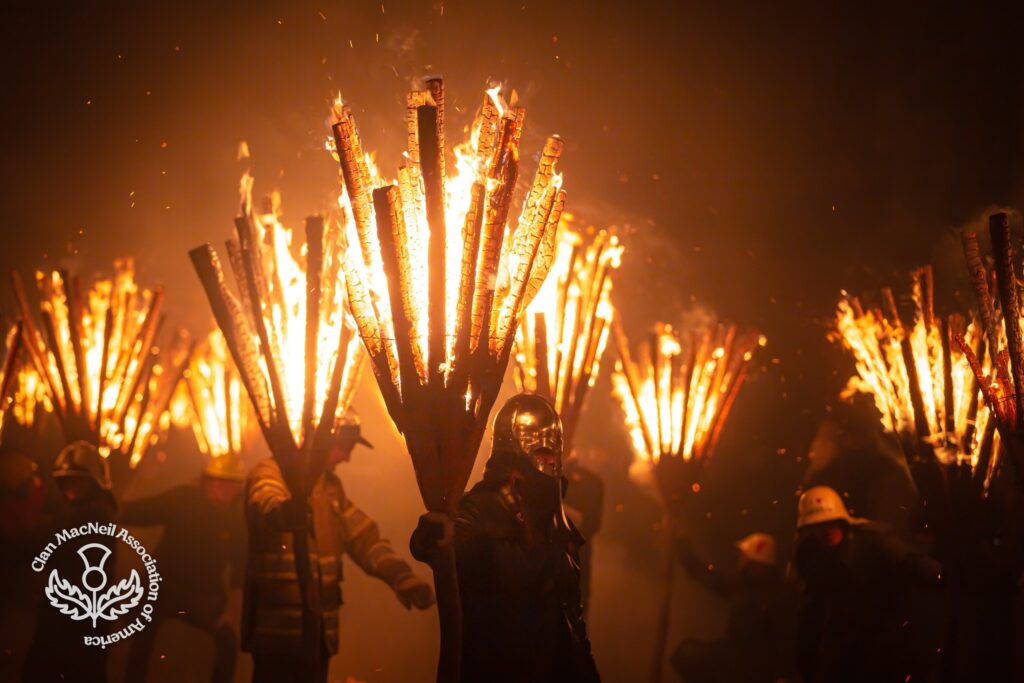
Bonfires were at the heart of it. Across Scotland, fires blazed on hilltops on October 31. Their light held back anything with ill intent until the sun came up. In parts of the Highlands, people carried burning torches around their homes and fields, sunwise, for protection. If you’ve ever wondered why so much of the Scottish autumn smells of woodsmoke, this is one very old reason.
Guising: the ancestor of trick-or-treating
Scottish children didn’t trick-or-treat. They went guising, from the word “disguise.” They dressed up, often as spirits themselves, to blend in with whatever was roaming that night. Then they went door to door and earned their treat with a song, a poem, or a joke. Many Scottish children still do it this way. That “party piece” before the sweets is the clearest difference from the American version.
Before the pumpkin, the turnip
Jack-o’-lanterns started life as turnips. Scots hollowed out a neep (or tumshie) and carved a fearsome face. A candle inside frightened off unwelcome visitors. Anyone who has tried carving a raw turnip will tell you it is hard work. When Scots and Irish emigrants reached North America, they found pumpkins far easier to carve, and the rest is history.
Peeking into the future
With the veil thin, Samhain was the best night of the year for divination. Much of it centered on love and marriage. A couple might set two nuts side by side on the fire. If they burned quietly, it meant a happy match. If they hissed and spat, a stormy one. Young people pulled kale stalks from the garden in the dark. The stalk’s height and shape foretold the figure of a future spouse. Apples, long associated with the otherworld, showed up in “dooking,” the Scottish name for bobbing for apples. Robert Burns gathered many of these customs into his 1785 poem “Halloween.” It is still one of the best windows into how ordinary Scots spent the night.
Wells, wishes, and a strip of cloth
Not every Samhain custom was about warding off the dark. Some were about asking for help. Samhain was a favored day for visiting Scotland’s clootie wells. At these sacred springs, people tied strips of cloth to nearby branches as offerings to the spirit of the well. Walk into the woods at Munlochy on the Black Isle today, and the trees still hang thick with cloth. The Galley tells the full story behind these wells in “Clootie Wells: The Celtic Wishing Trees.” It runs from their pre-Christian roots to a Reformation-era ban to a rather startling cure once attempted at Munlochy.
From Samhain to Halloween
So is Halloween just Samhain with a new name? It’s a little more tangled than that. The name itself is Christian. In the 8th century, the church’s All Saints’ Day, or All Hallows, moved to November 1. The night before became All Hallows’ Eve, which Scots shortened to Hallowe’en. Historians still debate whether the date was chosen to absorb Samhain or simply landed there. Either way, the two festivals shared the same night for more than a thousand years. The bonfires, the guisers, the lanterns, and the fortune-telling came along for the ride.
This year, when a small ghost turns up at your door, you might ask for a song first. It would be the traditional thing to do.
Read the Full Story in The Galley
If the clootie wells caught your imagination, read more in “Clootie Wells: The Celtic Wishing Trees.” It appears in Issue 64, the Spring/Summer 2022 edition of The Galley. CMAA members can read the full issue online in the member area of the Clan MacNeil Association of America website.
Not a member yet? This is the kind of history, custom, and heritage that arrives in every issue of The Galley. Join the Clan MacNeil Association of America and it will start arriving in your mailbox, too.