Three Islands, One Clan
Clan MacNeil did not come from one place. It came from three. Barra, Colonsay, and Gigha are the island homelands of the MacNeils: small, remote, wind-swept places off the western coast of Scotland that shaped the clan’s character as profoundly as its history. One of CMAA’s founding purposes is to support these homelands, and understanding them is part of understanding who we are.
The Isle of Barra
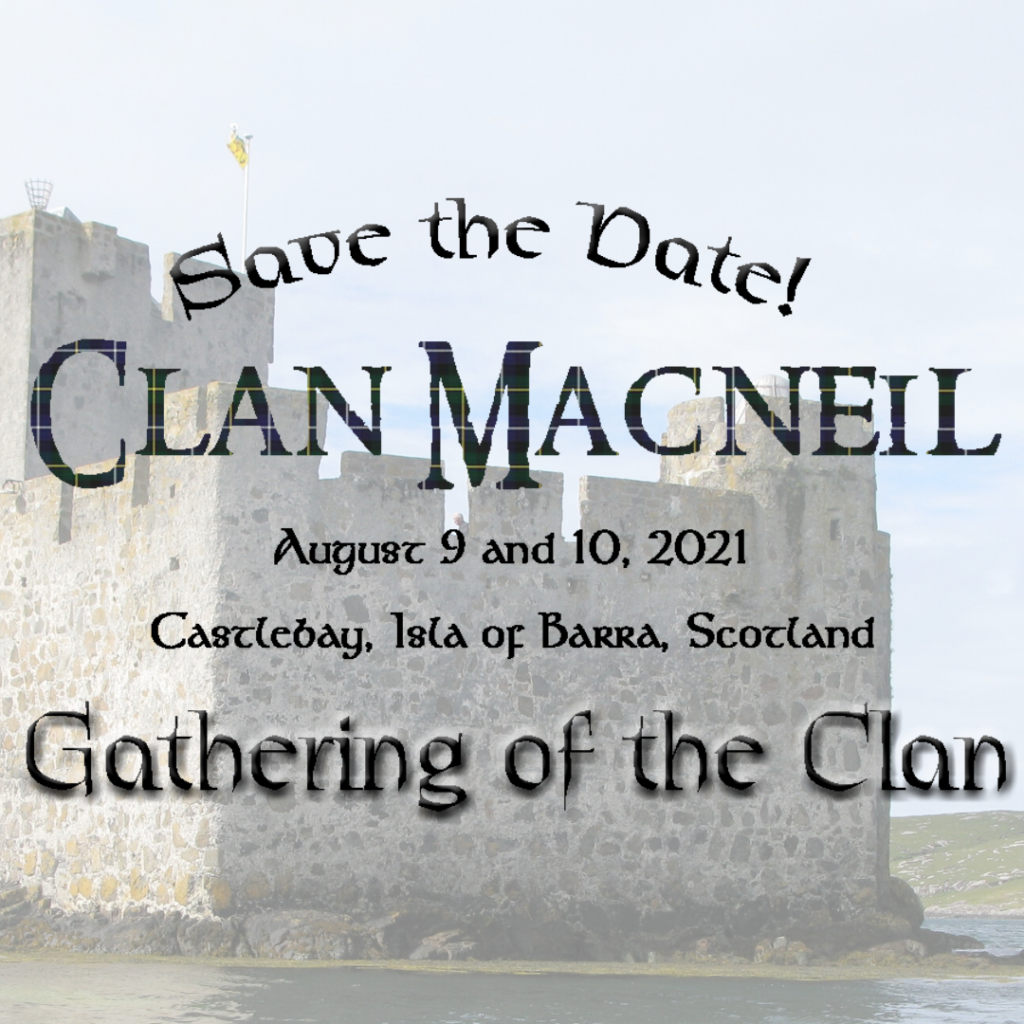
Barra is the seat of the chief and the heart of Clan MacNeil identity. Niall, the clan’s founding ancestor, established himself on Barra in 1049 and the MacNeils held the island for centuries. At its center, rising from the bay at Castlebay, sits Kisimul Castle: a small stone fortress on a rock in the water, the ancient stronghold of the chiefs of Clan MacNeil.
Kisimul is known as the Castle in the Sea, and the name earns itself. You reach it by a five-minute boat trip from the village of Castlebay. The current chief, the 46th MacNeil of Barra, leased the castle to Historic Environment Scotland for 1,000 years at a rent of one pound and a bottle of whisky per year. It is open to visitors in season and is one of the most atmospheric places in all of Scotland.
Barra today is a small community of around 1,200 people, predominantly Gaelic-speaking, with a strong sense of its own identity and a determination to survive as a living community rather than a heritage site. The island has its own airport, famously the only scheduled airport in the world where the runway is a beach and flights are timed around the tides.
Supporting Barra
CMAA’s mission includes supporting the Barra community. The simplest way to do that is to visit, to buy from island producers, and to stay in locally owned accommodation. The Isle of Barra Distillers and the community organizations below are good starting points.
- Isle of Barra
- Guth Bharraidh — the voice of Barra community
- Buth Bharraigh: Barra’s community retail outlet
- Clan Macneil of Barra Facebook Group
The Isle of Colonsay
Colonsay is a small island in the Inner Hebrides, home to the McNeills of Colonsay, the southern branch of the clan. Where the Barra MacNeils dominated the Outer Hebrides, the Colonsay branch established themselves in the calmer waters of the Inner Isles. The two branches developed their own distinct heraldry, their own crest badges and coats of arms, reflecting their separate development over the centuries.
Colonsay today has a permanent population of around 130 people. It is remote, quiet, and genuinely beautiful. The island is largely owned by a single estate and is known for its gardens, its priory ruins, and its extraordinary tidal causeway to the neighbouring island of Oronsay, which can be crossed on foot at low tide.
The Isle of Gigha
Gigha sits just off the Kintyre peninsula in Argyll. The McNeills of Gigha established themselves here under Torquil MacNeil in 1427, and the island remained part of the MacNeil world for generations. After 1493, the Gigha branch aligned with Clan Donald in the long feud between the MacDonalds of Islay and the MacLeans of Duart, while the Barra MacNeils sided with the MacLeans. Two branches of the same clan on opposite sides of one of the defining conflicts of the Western Isles.
Gigha’s modern story is one of the most remarkable in Scotland. In 2002, after centuries of private ownership, the community of Gigha bought the island themselves through a community land buyout. Around 100 residents now own their island collectively, a model of community resilience that has inspired similar efforts across the Highlands and Islands.
Visiting the Homelands
All three islands are reachable by ferry from the Scottish mainland, and all three reward the effort of getting there. Barra is served by Caledonian MacBrayne ferries from Oban, with the famous beach landing at Traigh Mhòr for air travellers. Colonsay is served from Oban and Kennacraig. Gigha is a short crossing from Tayinloan on the Kintyre peninsula.
CMAA members who have made the journey consistently describe it as something that changes how they understand their own history. The islands are not large or dramatic in the way of the mainland Highlands. They are quiet, particular, and unmistakably themselves. That is the MacNeil way.