A Warrior Tradition
Scotland’s history was shaped by conflict, and the weapons its people carried were not simply tools of war. They were markers of identity, rank, and clan loyalty. For Clan MacNeil, whose chiefs raided ships from Kisimul Castle and whose clansmen fought at Bannockburn, Killiecrankie, and the Rising of 1715, the warrior tradition runs deep. Understanding Highland arms is part of understanding who the MacNeils were.
Scotland at the Forefront of Arms Development
The history of Scottish weapons is not widely known, which is surprising given Scotland’s role in European arms development. Scottish smiths were particularly advanced in the development of firearms during the 16th and 17th centuries, and the basket-hilted broadsword, developed in Scotland during the same period, became one of the most sophisticated sword designs in Europe. The Highland warrior was not a primitive fighter. He was equipped with weapons that reflected genuine technical innovation.
The Principal Highland Weapons
The Highland warrior’s kit evolved over centuries but by the 17th and 18th centuries had settled into a recognizable set of arms.
The claymore, from the Gaelic claidheamh mor meaning “great sword,” was the primary weapon of Highland warfare. The two-handed version, used from the 14th through 16th centuries, was a massive weapon requiring significant strength and space to wield effectively. By the 17th century the term had shifted to describe the basket-hilted broadsword, a one-handed weapon paired with a targe for close combat.
The targe was the Highland shield: small, round, typically around 18 inches in diameter, made of wood covered in leather and often decorated with brass studs in Celtic patterns. It was held on the left arm, used to deflect blows and create openings for the sword arm. Some targes were fitted with a central spike that could be used offensively at close quarters.
The dirk was the Highland dagger, carried at the belt and used when fighting came too close for a sword. A well-made dirk was a significant piece of craftsmanship, with a blade typically 12 to 17 inches long and a handle of carved wood or antler. The dirk remains part of formal Highland dress today, worn at the right hip.
The sgian-dubh, meaning “black knife” in Gaelic, is the small knife worn tucked into the top of the right stocking as part of Highland dress. Its origins are debated but it appears to have developed from a concealed personal knife carried inside clothing. Today it is purely ceremonial, but it is one of those small details of Highland dress that carries genuine historical weight.
Meet the Clan Armorer
CMAA’s own Clan Armorer, Tim Morris, keeps this tradition alive at Highland Games events across the Southeast. Tim brings historical arms and armor to the clan tent and shares his knowledge with members and visitors, connecting the physical objects to the history they represent. If you have had the chance to stop by the clan tent when Tim is there, you already know how much depth there is to this subject. If you have not, it is worth making the effort at your next games.
Highland Dress and Weaponry Today
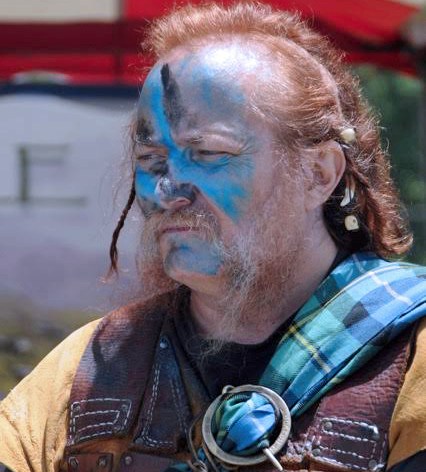
Several of the traditional Highland weapons survive as components of formal Highland dress. The dirk, the sgian-dubh, and the sporran all trace their origins to functional items carried by Highland warriors. Wearing them today is a small act of historical continuity, connecting the wearer to centuries of clan tradition even if the context has changed entirely.
The full Highland kit worn at a clan gathering or a formal dinner is not a costume. It is a living tradition, and the weapons that are part of it carry real history in their design.